Cuando la interacción importa: Randall Collins y el redescubrimiento de la vida cotidiana
 Marcelo Astorga Veloso
Publicado en julio 31, 2026
Marcelo Astorga Veloso
Publicado en julio 31, 2026
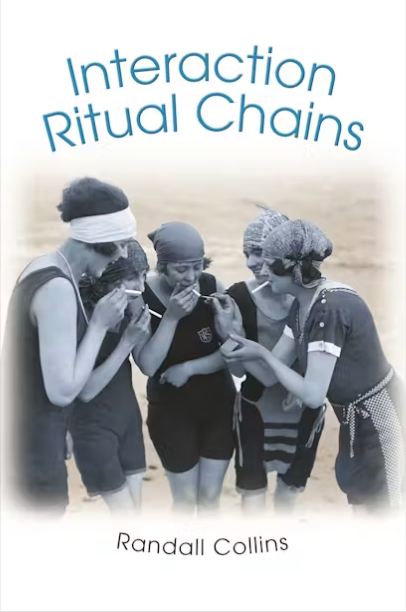
¿Puede una teoría sobre la interacción cambiar la forma en que entendemos la intervención social?
¿Por qué algunas experiencias colectivas permanecen con nosotros durante años, mientras otras desaparecen apenas terminan? ¿Qué hace que una fiesta popular, una ceremonia religiosa, una reunión vecinal o incluso un recorrido patrimonial nos hagan sentir parte de algo más grande que nosotros mismos?
Durante mucho tiempo, las ciencias sociales respondieron estas preguntas mirando las características de las personas: sus opiniones, valores, motivaciones o identidades. La atención se concentró en lo que los individuos pensaban. Sin embargo, hace poco más de dos décadas, un sociólogo norteamericano propuso cambiar radicalmente la pregunta.
En lugar de preguntarnos qué piensa la gente, Randall Collins (Profesor de Sociologia de la University of Pennsylvania) propuso observar y teorizar sobre qué ocurre cuando las personas interactúan.
“radical microsociology”.
Su punto de partida parece sencillo, pero tiene consecuencias profundas. La sociedad no se sostiene únicamente por normas, instituciones o estructuras. También se produce continuamente mediante miles de encuentros cotidianos: conversaciones, celebraciones, ceremonias, reuniones, clases, manifestaciones o comidas compartidas. Cuando esas interacciones reúnen ciertas condiciones —copresencia física, un foco común de atención, emociones compartidas y fronteras simbólicas que distinguen a quienes participan— se transforman en lo que Collins denomina cadenas de rituales de interacción.
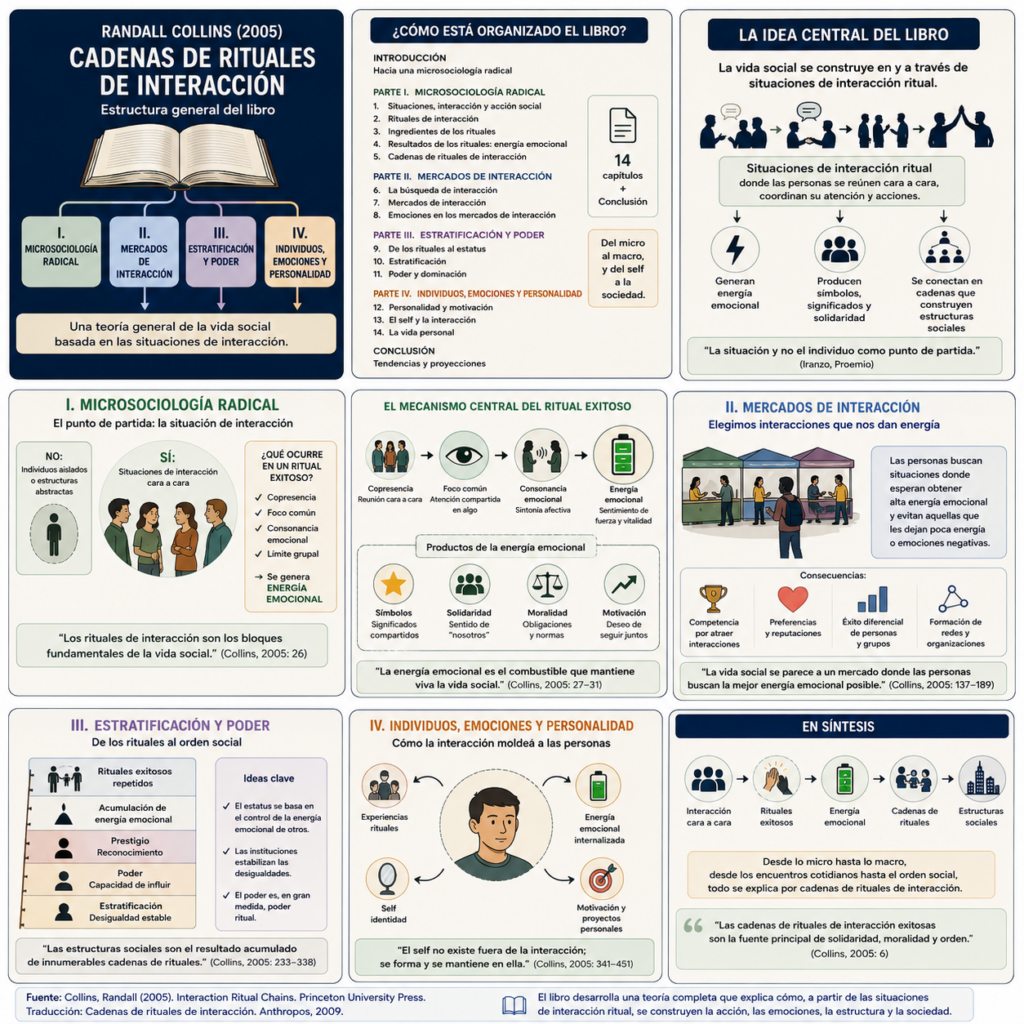
Estos rituales no son necesariamente religiosos ni solemnes. Una reunión de trabajo, un partido de fútbol, una marcha, una comida familiar o una visita guiada pueden convertirse en rituales exitosos. Lo importante no es el contenido de la actividad, sino la forma en que las personas logran sincronizar su atención y compartir una experiencia.
Cuando ello ocurre, sostiene Collins, se produce un resultado fundamental: energía emocional. No se trata simplemente de alegría o entusiasmo momentáneo, sino de un estado relativamente duradero de confianza, iniciativa, compromiso y disposición para volver a participar. Esa energía hace que algunas experiencias permanezcan vivas mucho después de haber terminado.
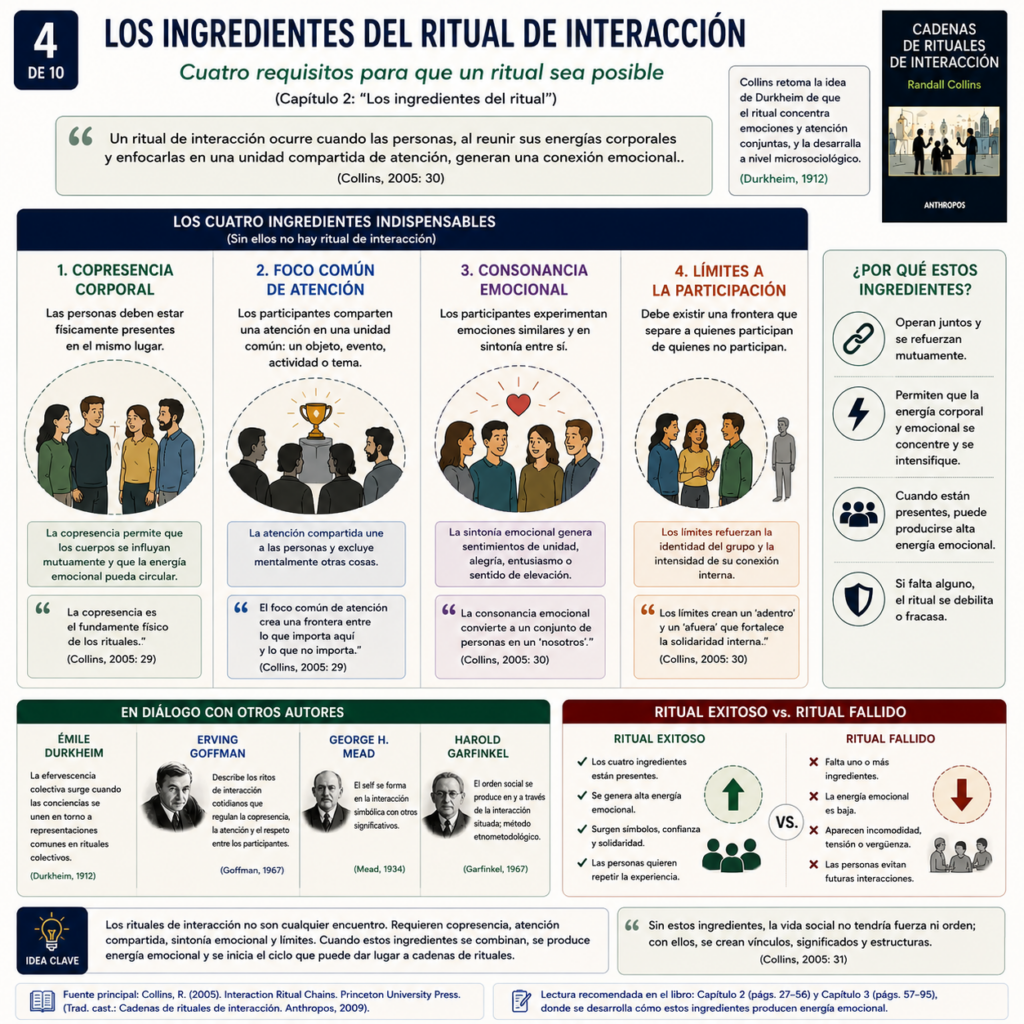
Pero la teoría va aún más lejos. Las personas tienden a buscar nuevamente aquellas situaciones que les proporcionaron alta energía emocional y a evitar aquellas que produjeron frustración o indiferencia. Así se forman las cadenas de rituales de interacción: secuencias de experiencias compartidas que van construyendo pertenencia, confianza, identidad colectiva y memoria.
Durante años, esta propuesta fue considerada una de las contribuciones más sugerentes de la microsociología contemporánea. Sin embargo, también recibió una crítica frecuente: era una teoría elegante, pero difícil de «demostrar» o aplicar empíricamente.
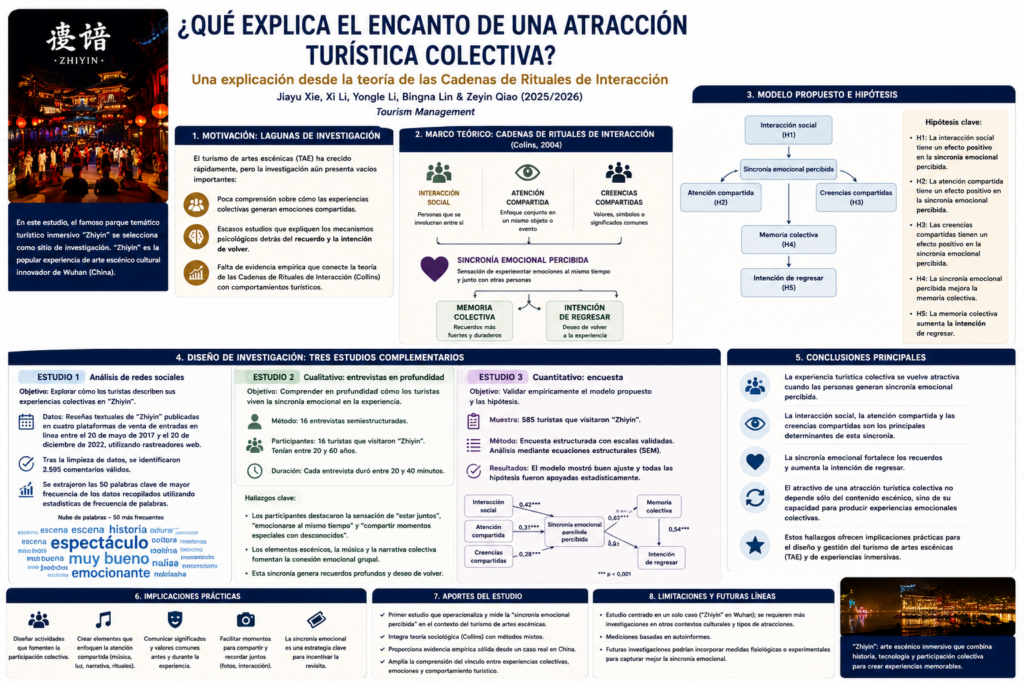
Un estudio reciente publicado en Tourism Management por Jiayu Xie y colaboradores constituye uno de los intentos más interesantes por responder ese desafío. Los investigadores estudiaron «Zhiyin», una innovadora experiencia de turismo inmersivo desarrollada en Wuhan (China), donde el público deja de ser un simple espectador para integrarse activamente a la representación.
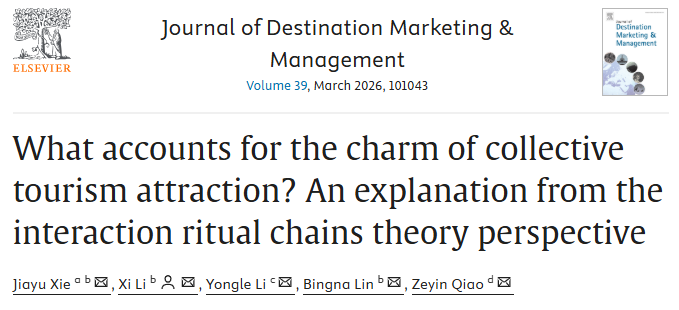
https://www.sciencedirect.com/science/article/pii/S2212571X25000551
El estudio se enfoca en el uso del «Tourism Performing Arts (TPA)» definiendolo como «forms of performing arts that are offered to tourists in tourist destinations, including traditional dance, music, drama, and large-scale live performances».
El diseño de la investigación combinó tres estudios complementarios. Primero, analizaron 2.595 reseñas publicadas por visitantes en plataformas digitales entre el 20 de mayo de 2017 y el 20 de diciembre de 2022 para identificar los conceptos que aparecían con mayor frecuencia. Luego realizaron 16 entrevistas en profundidad con turistas de distintas edades para comprender cómo describían su experiencia. Finalmente aplicaron una encuesta a 585 visitantes, poniendo a prueba estadísticamente el modelo derivado de la teoría de Collins.
Los resultados fueron consistentes. Lo que mejor explicaba el atractivo de la experiencia no era únicamente la calidad del espectáculo, sino la sensación de vivir algo junto a otras personas. La interacción social, la atención compartida y los significados comunes favorecían lo que los autores denominaron sincronía emocional percibida (Perceived emotional synchrony). Esa sincronía fortalecía los recuerdos de la experiencia y aumentaba significativamente la intención de volver.
La conclusión resulta sugerente. No recordamos solamente un lugar. Recordamos la experiencia compartida que vivimos en él.
Quizá aquí exista una lección que trasciende el turismo. Si una teoría sobre los rituales de interacción ayuda a comprender por qué ciertas experiencias colectivas permanecen en la memoria de quienes las viven, ¿podría también ayudarnos a comprender por qué algunas intervenciones sociales logran reconstruir vínculos, mientras otras apenas producen diagnósticos, informes o indicadores?
No tengo todavía una respuesta definitiva. Pero sospecho que esta pregunta merece ser explorada.
Tal vez las intervenciones sociales no fracasan únicamente por falta de recursos, coordinación institucional o buenas metodologías. Quizá también necesitamos comprender con mayor profundidad aquello que sucede cuando las personas se encuentran, conversan, recuerdan y construyen, poco a poco, una historia compartida. Porque es posible que, antes de transformar una comunidad, debamos entender cómo se producen esos pequeños procesos cotidianos que hacen posible la confianza, la pertenencia y la cooperación.
BIBLIOGRAFIA DEL ARTICULO DE XIE 2026.
References
- Ahn et al., 2017Y.J. Ahn, S.S. Hyun, I. KimVivid-memory formation through experiential value in the context of the international industrial exhibitionJournal of Travel & Tourism Marketing, 34 (3) (2017), pp. 291-311, 10.1080/10548408.2016.1156617View at publisherView in ScopusGoogle Scholar
- Ali et al., 2016F. Ali, K. Ryu, K. HussainInfluence of experiences on memories, satisfaction and behavioral intentions: A study of creative tourismJournal of Travel & Tourism Marketing, 33 (1) (2016), pp. 85-100, 10.1080/10548408.2015.1038418View at publisherView in ScopusGoogle Scholar
- Alvarsson et al., 2010J.J. Alvarsson, S. Wiens, M.E. NilssonStress recovery during exposure to nature sound and environmental noiseInternational Journal of Environmental Research and Public Health, 7 (3) (2010), pp. 1036-1046, 10.3390/ijerph7031036View at publisherView in ScopusGoogle Scholar
- Baker, 2018C. BakerSummary of exploring a three-dimensional narrative medium: The theme park as “de Sprookjessprokkelaar,” the gatherer and teller of storiesJournal of Themed Experience and Attractions Studies, 1 (1) (2018), pp. 1-9Google Scholar
- Bargeman and Richards, 2020B. Bargeman, G. RichardsA new approach to understanding tourism practicesAnnals of Tourism Research, 84 (2020), Article 102988, 10.1016/j.annals.2020.102988View PDFView articleView in ScopusGoogle Scholar
- Breiby and Slåtten, 2015M.A. Breiby, T. SlåttenThe effects of aesthetic experiential qualities on tourists positive emotions and loyalty: A case of a nature-based context in NorwayJournal of Quality Assurance in Hospitality & Tourism, 16 (4) (2015), pp. 323-346, 10.1080/1528008X.2015.1016591View in ScopusGoogle Scholar
- Castro-Abril et al., 2021P. Castro-Abril, S. Da Costa, G. Navarro-Carrillo, A. Caicedo-Moreno, M. Gracia-Leiva, P. Bouchat, …, D. PaezSocial identity, perceived emotional synchrony, creativity, social representations, and participation in social movements: The case of the 2019 Chilean populist protestsFrontiers in Psychology, 12 (2021), Article 764434, 10.3389/fpsyg.2021.764434View in ScopusGoogle Scholar
- Chen et al., 2021Y. Chen, Z. Lin, R. Filieri, R. LiuSubjective well-being, mobile social media and the enjoymeourism experience: A broaden-and-build perspectiveAsia Pacific Journal of Tourism Research, 26 (10) (2021), pp. 1070-1080, 10.1080/10941665.2021.1952285View at publisherView in ScopusGoogle Scholar
- Cheng et al., 2016Q. Cheng, L. Fang, H. ChenVisitors’ brand loyalty to a historical and cultural theme park: A case study of Hangzhou Songcheng, ChinaCurrent Issues in Tourism, 19 (9) (2016), pp. 861-868, 10.1080/13683500.2015.1006589View at publisherView in ScopusGoogle Scholar
- China Association of Performing Arts, 2024China Association of Performing ArtsNational performance market development briefing 2023Retrieved 20.03.2024. fromhttps://www.capa.com.cn/#/index/NewsDetail?activeName=%E5%B8%82%E5%9C%BA%E8%A7%82%E5%AF%9F&id=1771015092454821890 (2024)Google Scholar
- Cohen, 1988J. CohenStatistical power analysis for the behavioral sciences (2nd edErlbaum, Hillsdale, NJ (1988)Google Scholar
- Collins, 2004R. CollinsInteraction ritual chainsPrinceton University Press (2004)Google Scholar
- Collins, 2014R. CollinsInteraction ritual chains and collective effervescenceCollective emotions, Oxford University Press, Oxford (2014)Google Scholar
- Conway and Pleydell-Pearce, 2000M.A. Conway, C.W. Pleydell-PearceThe construction of autobiographical memories in the self-memory systemPsychological Review, 107 (2) (2000), p. 261, 10.1037/0033-295X.107.2.261View at publisherView in ScopusGoogle Scholar
- Creswell et al., 2003J.W. Creswell, V.L.P. Clark, M.L. Gutmann, W.E. HansonAdvanced mixedHandbook of mixed methods in social & behavioral research, 209 (2003), pp. 209-240View in ScopusGoogle Scholar
- Ding and Hung, 2021H.-M. Ding, K.-P. HungThe antecedents of visitors’ flow experience and its influence on memory and behavioral intentions in the music festival contextJournal of Destination Marketing & Management, 19 (2021), Article 100551, 10.1016/j.jdmm.2020.100551View PDFView articleView in ScopusGoogle Scholar
- Durkheim, 1912E. DurkheimThe elementary forms of the religious lifeFree Press, New York, NY (1912)Google Scholar
- Elbaz et al., 2023A.M. Elbaz, M.S. Abou Kamar, A.K.E. Onjewu, M. SolimanEvaluating the antecedents of health destination loyalty: The moderating role of destination trust and tourists’ emotionsInternational Journal of Hospitality & Tourism Administration, 24 (1) (2023), pp. 1-28, 10.1080/15256480.2021.1935394View in ScopusGoogle Scholar
- Fornell and Larcker, 1981C. Fornell, D.F. LarckerEvaluating structural equation models with unobservable variables and measurement errorJournal of Marketing Research, 18 (1) (1981), pp. 39-50, 10.1177/002224378101800104Google Scholar
- Fu et al., 2023X. Fu, C. Baker, W. Zhang, R. ZhangTheme park storytelling: Deconstructing immersion in Chinese theme parksJournal of Travel Research, 62 (4) (2023), pp. 893-906, 10.1177/00472875221098933Google Scholar
- Fusch and Ness, 2015P.I. Fusch, L.R. NessAre we there yet? Data saturation in qualitative researchQualitative Report, 20 (2015), pp. 1408-1416, 10.46743/2160-3715/2015.2281View in ScopusGoogle Scholar
- Garson, 2012G.D. GarsonTesting statistical assumptions. Asheboro, NCStatistical Associates Publishing (2012)Google Scholar
- Gilbert, 1987M. GilbertModelling collective beliefSynthese, 73 (1) (1987), pp. 185-204, 10.1007/BF00485446View in ScopusGoogle Scholar
- Godovykh and Tasci, 2021M. Godovykh, A.D. TasciThe influence of post-visit emotions on destination loyaltyTourism Review, 76 (1) (2021), pp. 277-288, 10.1108/TR-01-2020-0025View in ScopusGoogle Scholar
- Goldenberg et al., 2020A. Goldenberg, D. Garcia, E. Halperin, J.J. GrossCollective emotionsCurrent Directions in Psychological Science, 29 (2) (2020), pp. 154-160, 10.1177/0963721420901574View in ScopusGoogle Scholar
- Gordon, 2013K.O. GordonEmotion and memory in nostalgia sport tourism: Examining the attraction to postmodern ballparks through an interdisciplinary lensJournal of Sport & Tourism, 18 (3) (2013), pp. 217-239, 10.1080/14775085.2013.846228View in ScopusGoogle Scholar
- Guest et al., 2006G. Guest, A. Bunce, L. JohnsonHow many interviews are enough? An experiment with data saturation and variabilityField Methods, 18 (1) (2006), pp. 59-82, 10.1177/1525822X05279903View in ScopusGoogle Scholar
- Hair et al., 2010J.F. Hair, R.E. Anderson, B.J. Babin, W.C. BlackMultivariate data analysis: A global perspectivePearson, Upper Saddle River, NJ (2010)Google Scholar
- Hammarström, 2005G. HammarströmThe construct of intergenerational solidarity in a lineage perspective: A discussion on underlying theoretical assumptionsJournal of Aging Studies, 19 (1) (2005), pp. 33-51, 10.1016/j.jaging.2004.03.009View PDFView articleView in ScopusGoogle Scholar
- Henseler et al., 2015J. Henseler, C.M. Ringle, M. SarstedtA new criterion for assessing discriminant validity in variance-based structural equation modelingJournal of the Academy of Marketing Science, 43 (1) (2015), pp. 115-135, 10.1007/s11747-014-0403-8View at publisherView in ScopusGoogle Scholar
- Hernández et al., 2018J.M. Hernández, A.P. Kirilenko, S. StepchenkovaNetwork approach to tourist segmentation via user generated contentAnnals of Tourism Research, 73 (2018), pp. 35-47, 10.1016/j.annals.2018.09.002View PDFView articleView in ScopusGoogle Scholar
- Hosany and Witham, 2010S. Hosany, M. WithamDimensions of cruisers’ experiences, satisfaction, and intention to recommendJournal of Travel Research, 49 (3) (2010), pp. 351-364, 10.1177/0047287509346859View at publisherView in ScopusGoogle Scholar
- Huang et al., 2023T.L. Huang, H.F. Chung, X. ChenDigital modality richness drives vivid memory experienceThe Journal of Research in Indian Medicine, 17 (6) (2023), pp. 921-939https://doi-org.1521.top/10.1108/JRIM-10-2022-0334View at publisherCrossrefView in ScopusGoogle Scholar
- Huang and Hsu, 2010J. Huang, C.H. HsuThe impact of customer-to-customer interaction on cruise experience and vacation satisfactionJournal of Travel Research, 49 (1) (2010), pp. 79-92, 10.1177/0047287509336466View at publisherView in ScopusGoogle Scholar
- Io, 2019M.U. IoUnderstanding the core attractiveness of performing arts heritage to international touristsTourism Geographies, 21 (4) (2019), pp. 687-705, 10.1080/14616688.2019.1571096View at publisherView in ScopusGoogle Scholar
- Ittamalla and Srinivas Kumar, 2021R. Ittamalla, D.V. Srinivas KumarRole of service experience on vivid memory and loyaltyInternational Journal of Hospitality & Tourism Administration, 22 (2) (2021), pp. 190-212, 10.1080/15256480.2019.1598910View in ScopusGoogle Scholar
- Jacoby, 2002J. JacobyStimulus‐organism‐response reconsidered: an evolutionary step in modeling (consumer) behaviorJournal of Consumer Psychology, 12 (1) (2002), pp. 51-57, 10.1207/S15327663JCP1201_05View PDFView articleView in ScopusGoogle Scholar
- Jakobs et al., 2001E. Jakobs, A.S. Manstead, A.H. FischerSocial context effects on facial activity in a negative emotional settingEmotion, 1 (1) (2001), p. 51, 10.1037//1528-3542.1.1.51View in ScopusGoogle Scholar
- Jedlowski, 2001P. JedlowskiMemory and sociology: Themes and issuesTime & Society, 10 (1) (2001), pp. 29-44, 10.1177/0961463X01010001002View in ScopusGoogle Scholar
- Jiang and Yan, 2022J. Jiang, B. YanFrom soundscape participation to tourist loyalty in nature-based tourism: The moderating role of soundscape emotion and the mediating role of soundscape satisfactionJournal of Destination Marketing & Management, 26 (2022), Article 100730, 10.1016/j.jdmm.2022.100730View PDFView articleView in ScopusGoogle Scholar
- Joo et al., 2020D. Joo, H. Cho, K.M. Woosnam, C. SuessRe-theorizing social emotions in tourism: Applying the theory of interaction ritual in tourism researchJournal of Sustainable Tourism (2020), pp. 1-16, 10.1080/09669582.2020.1849237View in ScopusGoogle Scholar
- Joo and Woosnam, 2020D. Joo, K.M. WoosnamMeasuring tourists’ emotional solidarity with one another—a modification of the emotional solidarity scaleJournal of Travel Research, 59 (7) (2020), pp. 1186-1203, 10.1177/0047287519878503View in ScopusGoogle Scholar
- Joo and Woosnam, 2022D. Joo, K.M. WoosnamTraveling to feel connected: Origins and outcomes of potential faith-based tourists’ emotional solidarityJournal of Travel & Tourism Marketing, 39 (1) (2022), pp. 42-57, 10.1080/10548408.2022.2045245View in ScopusGoogle Scholar
- Kamath et al., 2021V. Kamath, M.A. Ribeiro, K.M. Woosnam, J. Mallya, G. KamathDeterminants of visitors’ loyalty to religious sacred event places: A multigroup measurement invariance modelJournal of Travel Research, 62 (1) (2021), pp. 176-196, 10.1177/00472875211057600Google Scholar
- Kim and Choi, 2016H.S. Kim, B. ChoiThe effects of three customer-to-customer interaction quality types on customer experience quality and citizenship behavior in mass service settingsJournal of Services Marketing, 30 (4) (2016), pp. 384-397, 10.1108/JSM-06-2014-0194View articleView in ScopusGoogle Scholar
- Kim et al., 2018S. Kim, J.Y. Chung, J. Petrick, J.W. ParkDetermination of preferred performing arts tourism products using conjoint analysisJournal of Vacation Marketing, 24 (1) (2018), pp. 44-61, 10.1016/j.jaging.2004.03.009View in ScopusGoogle Scholar
- Kim and Lee, 2019S. Kim, W.S. LeeNetwork text analysis of medical tourism in newspapers. using text mining: The South Korea caseTourism Management Perspectives, 31 (2019), pp. 332-339, 10.1016/j.tmp.2019.05.010View PDFView articleGoogle Scholar
- Kim and Youn, 2017J.-H. Kim, H. YounHow to design and deliver stories about tourism destinationsJournal of Travel Research, 56 (6) (2017), pp. 808-820, 10.1177/0047287516666720Google Scholar
- Kline, 2023R.B. KlinePrinciples and practice of structural equation modeling(4th ed.), Guilford publications, New York, NY (2023)Google Scholar
- Lai et al., 2021I.K.W. Lai, Y. Liu, D. LuThe effects of tourists’ destination culinary experience on electronic word-of-mouth generation intention: The experience economy theoryAsia Pacific Journal of Tourism Research, 26 (3) (2021), pp. 231-244, 10.1080/10941665.2020.1851273View in ScopusGoogle Scholar
- Lee et al., 2020S. Lee, D. Joo, C.-K. Lee, K.M. WoosnamKorean DMZ tourists’ perceived similarity and shared beliefs in predicting place attachment and support for tourism developmentJournal of Destination Marketing & Management, 18 (2020), Article 100467, 10.1016/j.jdmm.2020.100467View PDFView articleView in ScopusGoogle Scholar
- Lin et al., 2019H. Lin, M. Zhang, D. Gursoy, X. FuImpact of tourist-to-tourist interaction on tourism experience: The mediating role of cohesion and intimacyAnnals of Tourism Research, 76 (2019), pp. 153-167, 10.1016/j.annals.2019.03.009View PDFView articleView in ScopusGoogle Scholar
- Luo et al., 2023C.Y. Luo, C.H. Tsai, C.H. Su, M.H. ChenFrom stage to a sense of place: the power of tourism performing arts storytelling for sustainable tourism growthJournal of Travel & Tourism Marketing, 40 (8) (2023), pp. 728-743, 10.1080/10548408.2023.2293012View in ScopusGoogle Scholar
- Manthiou et al., 2017A. Manthiou, K. Ayadi, S. Lee, L. Chiang, L. TangExploring the roles of self-concept and future memory at consumer events: The application of an extended Mehrabian–Russell modelJournal of Travel & Tourism Marketing, 34 (4) (2017), pp. 531-543, 10.1080/10548408.2016.1208786View in ScopusGoogle Scholar
- Manthiou et al., 2014A. Manthiou, S.A. Lee, L.R. Tang, L. ChiangThe experience economy approach to festival marketing: Vivid memory and attendee loyaltyJournal of Services Marketing, 28 (1) (2014), pp. 22-35, 10.1108/JSM-06-2012-0105View in ScopusGoogle Scholar
- Nguyen and Duong, 2025T.T.T. Nguyen, T.D.H. DuongThe role of nostalgic emotion in shaping destination image and behavioral intentions-an empirical studyJournal of Hospitality and Tourism Insights, 8 (2) (2025), pp. 735-752, 10.1108/JHTI-05-2024-0463View in ScopusGoogle Scholar
- Nicholls, 2011R. NichollsCustomer‐to‐customer interaction (CCI): A cross‐cultural perspectiveInternational Journal of Contemporary Hospitality Management, 23 (2) (2011), pp. 209-223https://doi-org.1521.top/10.1108/09596111111119338CrossrefView in ScopusGoogle Scholar
- Oliver Richard, 2010L. Oliver RichardSatisfaction: A behavioral perspective on the consumer(2th ed.), Routledge, New York, NY (2010)Google Scholar
- Plutchik, 1980R. PlutchikA general psychoevolutionary theory of emotionTheories of emotion (1980), pp. 3-33, 10.1016/B978-0-12-558701-3.50007-7View PDFView articleGoogle Scholar
- Podsakoff and Organ, 1986P.M. Podsakoff, D.W. OrganSelf-reports in organizational research: Problems and prospectsJournal of Management, 12 (4) (1986), pp. 531-544, 10.1177/014920638601200408View in ScopusGoogle Scholar
- Rasoolimanesh et al., 2021S.M. Rasoolimanesh, S. Seyfi, R. Rastegar, C.M. HallDestination image during the COVID-19 pandemic and future travel behavior: The moderating role of past experienceJournal of Destination Marketing & Management, 21 (2021), Article 100620, 10.1016/j.jdmm.2021.100620View PDFView articleView in ScopusGoogle Scholar
- Richards, 2014E.L. RichardsContracting from East to West: Bridging the cultural divideBusiness Horizons, 57 (5) (2014), pp. 677-684, 10.1016/j.bushor.2014.04.003View PDFView articleView in ScopusGoogle Scholar
- Richards, 2018G. RichardsCultural tourism: A review of recent research and trendsJournal of Hospitality and Tourism Management, 36 (2018), pp. 12-21, 10.1016/j.jhtm.2018.03.005View PDFView articleView in ScopusGoogle Scholar
- Rubin and Kozin, 1984D.C. Rubin, M. KozinVivid memoriesCognition, 16 (1) (1984), pp. 81-95, 10.1016/0010-0277(84)90037-4View PDFView articleView in ScopusGoogle Scholar
- Şahin and Güzel, 2020İ. Şahin, F.Ö. GüzelDo experiential destination attributes create emotional arousal and memory? A comparative research approachJournal of Hospitality Marketing & Management, 29 (8) (2020), pp. 956-986, 10.1080/19368623.2020.1746214Google Scholar
- Saldana, 2009J. SaldanaThe coding manual for qualitative researchers(2nd ed.), SAGE, Los Angeles, CA (2009)Google Scholar
- Salmela, 2013M. SalmelaThe functions of collective emotions in social groupsInstitutions, emotions, and group agents: Contributions to social ontology, Springer, Dordrecht (2013), pp. 159-176NetherlandsGoogle Scholar
- Sharpley, 2014R. SharpleyHost perceptions of tourism: A review of the researchTourism Management, 42 (2014), pp. 37-49, 10.1016/j.tourman.2013.10.007View PDFView articleView in ScopusGoogle Scholar
- Shi et al., 2022D. Shi, Y. Shan, Z. Zhao, S. ZhangIdentification and influence of tourism rituals: Analysis of eye movement recognition of tourism imagesJournal of Hospitality & Tourism Research, 46 (1) (2022), pp. 147-173, 10.1177/1096348021996783View in ScopusGoogle Scholar
- Spielmann et al., 2021N. Spielmann, A.D. Cruz, B.B. Tyler, K. BeukelPlace as a nexus for corporate heritage identity: An international study of family-owned wineriesJournal of Business Research, 129 (2021), pp. 826-837, 10.1016/j.jbusres.2019.05.024View PDFView articleView in ScopusGoogle Scholar
- Sterchele, 2020D. StercheleMemorable tourism experiences and their consequences: An interaction ritual (IR) theory approachAnnals of Tourism Research, 81 (2020), Article 102847, 10.1016/j.annals.2019.102847View PDFView articleView in ScopusGoogle Scholar
- Strauss and Corbin, 1998A. Strauss, J. CorbinBasics of qualitative research techniques(3rd ed.), Sage, Thousand Oaks, CA (1998)Google Scholar
- Stylidis, 2022D. StylidisExploring resident–tourist interaction and its impact on tourists’ destination imageJournal of Travel Research, 61 (1) (2022), pp. 186-201, 10.1177/0047287520969861View in ScopusGoogle Scholar
- Talarico and Rubin, 2007J.M. Talarico, D.C. RubinFlashbulb memories are special after all; in phenomenology, not accuracyApplied Cognitive Psychology: The Official Journal of the Society for Applied Research in Memory and Cognition, 21 (5) (2007), pp. 557-578, 10.1002/acp.1293View in ScopusGoogle Scholar
- Torres, 2016E.N. TorresGuest interactions and the formation of memorable experiences: An ethnographyInternational Journal of Contemporary Hospitality Management, 28 (10) (2016), pp. 2132-2155, 10.1108/IJCHM-02-2015-0065View articleView in ScopusGoogle Scholar
- Toti et al., 2021J.-F. Toti, M.F. Diallo, R. Huaman-RamirezEthical sensitivity in consumers’ decision-making: The mediating and moderating role of internal locus of controlJournal of Business Research, 131 (2021), pp. 168-182, 10.1016/j.jbusres.2021.03.045View PDFView articleView in ScopusGoogle Scholar
- Tung and Ritchie, 2011V.W.S. Tung, J.B. RitchieExploring the essence of memorable tourism experiencesAnnals of Tourism Research, 38 (4) (2011), pp. 1367-1386, 10.1016/j.annals.2011.03.009View PDFView articleView in ScopusGoogle Scholar
- Van der Zee and Bertocchi, 2018E. Van der Zee, D. BertocchiFinding patterns in urban tourist behaviour: A social network analysis approach based on TripAdvisor reviewsInformation Technology & Tourism, 20 (1) (2018), pp. 153-180, 10.1007/s40558-018-0128-5View in ScopusGoogle Scholar
- Verduyn and Lavrijsen, 2015P. Verduyn, S. LavrijsenWhich emotions last longest and why: The role of event importance and ruminationMotivation and Emotion, 39 (1) (2015), pp. 119-127, 10.1007/s11031-014-9445-yView in ScopusGoogle Scholar
- Volo, 2021S. VoloThe experience of emotion: Directions for tourism designAnnals of Tourism Research, 86 (2021), Article 103097, 10.1016/j.annals.2020.103097View PDFView articleView in ScopusGoogle Scholar
- Von Scheve and Ismer, 2013C. Von Scheve, S. IsmerTowards a theory of collective emotionsEmotion Review, 5 (4) (2013), pp. 406-413, 10.1177/1754073913484170View in ScopusGoogle Scholar
- Wlodarczyk et al., 2020A. Wlodarczyk, L. Zumeta, J.J. Pizarro, P. Bouchat, F. Hatibovic, N. Basabe, B. RiméPerceived emotional synchrony in collective gatherings: Validation of a short scale and proposition of an integrative measureFrontiers in Psychology, 11 (2020), p. 1721, 10.3389/fpsyg.2020.01721View in ScopusGoogle Scholar
- Wood, 2020E.H. WoodI remember how we all felt: Perceived emotional synchrony through tourist memory sharingJournal of Travel Research, 59 (8) (2020), pp. 1339-1352, 10.1177/0047287519888290View in ScopusGoogle Scholar
- Wood et al., 2024E.H. Wood, M. Kinnunen, J. Moss, Y. LiShared festival tourism experiences: The power and purpose of remembering togetherJournal of Travel Research, 63 (2) (2024), pp. 409-427, 10.1177/0047287523115859View at publisherView in ScopusGoogle Scholar
- Woosnam and Norman, 2010K.M. Woosnam, W.C. NormanMeasuring residents’ emotional solidarity with tourists: Scale development of Durkheim’s theoretical constructsJournal of Travel Research, 49 (3) (2010), pp. 365-380, 10.1177/0047287509346858View at publisherView in ScopusGoogle Scholar
- Woosnam et al., 2009K.M. Woosnam, W.C. Norman, T. YingExploring the theoretical framework of emotional solidarity between residents and touristsJournal of Travel Research, 48 (2) (2009), pp. 245-258, 10.1177/0047287509332334View at publisherView in ScopusGoogle Scholar
- Wu et al., 2020S.H. Wu, S.C.T. Huang, C.Y.D. Tsai, C.L. SungAs loyal as migratory birds: Analyzing event revisit intention with dramaturgy and environmental psychology theoriesAsia Pacific Journal of Tourism Research, 25 (8) (2020), pp. 841-857, 10.1080/10941665.2020.1768128View at publisherView in ScopusGoogle Scholar
- Xie and Li, 2023J. Xie, X. LiFrom theatrical elements to festival attendees’ perceived emotional synchrony: The perspective of interaction ritual chain theoryJournal of Hospitality and Tourism Management, 56 (2023), pp. 83-93, 10.1016/j.jhtm.2023.06.016View PDFView articleView in ScopusGoogle Scholar
- Yang and Wall, 2009L. Yang, G. WallAuthenticity in ethnic tourism: Domestic tourists’ perspectivesCurrent Issues in Tourism, 12 (3) (2009), pp. 235-254, 10.1080/13683500802406880View at publisherView in ScopusGoogle Scholar
- Yang et al., 2022Y. Yang, S. Wang, Y. Cai, X. ZhouHow and why does place identity affect residents’ spontaneous culture conservation in ethnic tourism community? A value co-creation perspectiveJournal of Sustainable Tourism, 30 (6) (2022), pp. 1344-1363, 10.1080/09669582.2021.1945070View in ScopusGoogle Scholar
- Younger et al., 2016D. Younger, T.T.W. Baxter, J. RohdeTheme park design & the art of themed entertainmentInklingwood Press (2016)Google Scholar
- Zhang, 2021R. ZhangExploration of social benefits for tourism performing arts industrialization in culture–tourism integration based on deep learning and artificial intelligence technologyFrontiers in Psychology, 12 (2021), Article 592925, 10.3389/fpsyg.2021.592925View in ScopusGoogle Scholar
- Zhang et al., 2023S. Zhang, N. Chen, C.H. Hsu, J.X. HaoMulti-Modal-based emotional contagion from tourists to hosts: The dual-process mechanismJournal of Travel Research, 62 (6) (2023), pp. 1328-1346, 10.1177/00472875221119975View in ScopusGoogle Scholar
- Zhang et al., 2022T. Zhang, B. Li, N. HuaChinese cultural theme parks: text mining and sentiment analysisJournal of Tourism and Cultural Change, 20 (1–2) (2022), pp. 37-57, 10.1080/14766825.2021.1876077View in ScopusGoogle Scholar
- Zheng et al., 2020D. Zheng, B.W. Ritchie, P. BenckendorffTourism performing arts development in ChinaHandbook on tourism and China, Edward Elgar Publishing, UK (2020), pp. 250-265View in ScopusGoogle Scholar
- Zheng et al., 2019D. Zheng, B.W. Ritchie, P.J. Benckendorff, J. BaoEmotional responses toward Tourism performing arts development: A comparison of urban and rural residents in ChinaTourism Management, 70 (2019), pp. 238-249, 10.1016/j.tourman.2018.08.019View PDFView articleView in ScopusGoogle Scholar
- Zheng et al., 2024Y. Zheng, J. Zhang, J. LiGamified experience design: A case study on China’s immersive tourist blocks in historic citiesFrontiers in Sustainable Tourism, 3 (2024), Article 1482203, 10.3389/frsut.2024.1482203View at publisherView in ScopusGoogle Scholar
- Zhou et al., 2023G. Zhou, Y. Liu, J. Hu, X. CaoThe effect of tourist-to-tourist interaction on tourists’ behavior: The mediating effects of positive emotions and memorable tourism experiencesJournal of Hospitality and Tourism Management, 55 (2023), pp. 161-168, 10.1016/j.jhtm.2023.03.005View PDFView articleView in ScopusGoogle Scholar
- Zhu, 2015Y. ZhuPerforming heritage: Authenticity in tourismJournal of Southwest University for Nationalities, 2015 (6) (2015), pp. 1-9, 10.1016/j.annals.2012.04.003

Tendencias